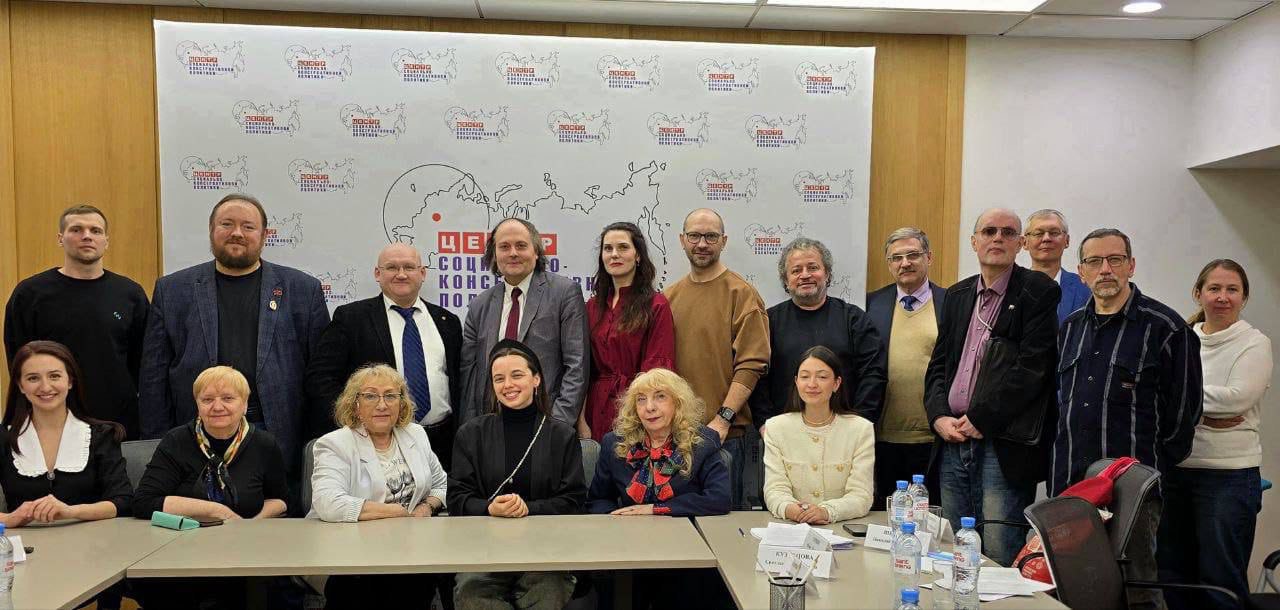
On December 3, a round table discussion entitled “The Russian World of Mikhail Chekhov” was held. The date was chosen to coincide with the 75th anniversary of the death of the outstanding actor, director, and teacher. The event was organized by the interregional public patriotic movement “Forever Alive,” the Secretariat of the Collective Security Treaty Organization, and the Center for Social Conservative Policy.
As part of the program, participants discussed a wide range of issues related to Mikhail Chekhov's creative legacy and the contemporary application of his method. The round table began with greetings from representatives of the CSTO, the leadership of MosITI, and the Mikhail Chekhov International Academy. The meeting was moderated by MosITI Rector Professor D. V. Tomilin and scientific expert of the “Forever Alive” Interregional Public Patriotic Movement N. V. Shelyapin.
Key topics were highlighted: Chekhov's role in the development of Russian and world theater, the distinctive features of his acting school, his influence on cinema and teaching practice, and the significance of his ideas in promoting traditional spiritual values. Particular attention was paid to the practical side of the method. The experts presented reports and an open lesson devoted to the actor's work with the body and imagination, stage speech, and the adaptation of the method for children's and amateur theaters. An important focus was placed on contemporary social initiatives that apply Mikhail Chekhov's method to provide psychological assistance to participants in the SVO and their families.
Speakers included actors, directors, theater teachers, producers, psychology specialists, representatives of public organizations, and educational institutions. The event concluded with a debate and the adoption of a final resolution. Representatives of the ANO “International Alliance of Strategic Projects BRICS” also took part in the round table, supporting the discussion of the international aspects of Mikhail Chekhov's creative legacy.
The round table provided a platform for professional exchange of experience and confirmed the continuing relevance of Mikhail Chekhov's method as one of the greatest achievements of the Russian theater school. The organizers thanked the participants for their insightful presentations and expressed their hope for the further development of joint projects in the fields of culture, education, and social support.
As part of the program, participants discussed a wide range of issues related to Mikhail Chekhov's creative legacy and the contemporary application of his method. The round table began with greetings from representatives of the CSTO, the leadership of MosITI, and the Mikhail Chekhov International Academy. The meeting was moderated by MosITI Rector Professor D. V. Tomilin and scientific expert of the “Forever Alive” Interregional Public Patriotic Movement N. V. Shelyapin.
Key topics were highlighted: Chekhov's role in the development of Russian and world theater, the distinctive features of his acting school, his influence on cinema and teaching practice, and the significance of his ideas in promoting traditional spiritual values. Particular attention was paid to the practical side of the method. The experts presented reports and an open lesson devoted to the actor's work with the body and imagination, stage speech, and the adaptation of the method for children's and amateur theaters. An important focus was placed on contemporary social initiatives that apply Mikhail Chekhov's method to provide psychological assistance to participants in the SVO and their families.
Speakers included actors, directors, theater teachers, producers, psychology specialists, representatives of public organizations, and educational institutions. The event concluded with a debate and the adoption of a final resolution. Representatives of the ANO “International Alliance of Strategic Projects BRICS” also took part in the round table, supporting the discussion of the international aspects of Mikhail Chekhov's creative legacy.
The round table provided a platform for professional exchange of experience and confirmed the continuing relevance of Mikhail Chekhov's method as one of the greatest achievements of the Russian theater school. The organizers thanked the participants for their insightful presentations and expressed their hope for the further development of joint projects in the fields of culture, education, and social support.
